• edited by
184 views
0 0 votes

The figure shows a two-generator system supplying a load of $P_D = 40$ MW, connected at bus $2$. 
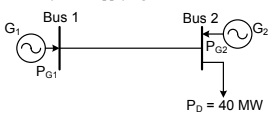
The fuel cost of generations $G_1$ and $G_2$ are:

$C_1(P_{G1})=10,000$ Rs/MWh and $C_2(P_{G2})=12,500$ Rs/MWh and the loss in the line is $P_{\text{loss(pu)}}=0.5 \: P_{G1(pu)}^2$, where the loss coefficient is specified in $pu$ on a $100$ MVA base. The most economic power generation schedule in MW is

  1. $P_{G1}=20$, $P_{G2}=22$
  2. $P_{G1}=22$, $P_{G2}=20$
  3. $P_{G1}=20$, $P_{G2}=20$
  4. $P_{G1}=0$, $P_{G2}=42$

Please log in or register to answer this question.

Related questions

0 0 votes
0 0 answers
277
277 views
Andrijana3306 asked Mar 23, 2018
277 views
A cylindrical rotor generator delivers $0.5$ pu power in the steady-state to an infinite bus through a transmission line of reactance $0.5$ pu. The generator no-load volt...
0 0 votes
0 0 answers
296
296 views
Andrijana3306 asked Mar 23, 2018
296 views
For the system shown below, $S_{D1}$ and $S_{D2}$ are complex power demands at bus $1$ and bus $2$ respectively. If $\mid V_2 \mid =1$ pu, the VAR rating of the capacitor...
0 0 votes
0 0 answers
211
211 views
Andrijana3306 asked Mar 23, 2018
211 views
The sequence components of the fault current are as follows: $I_{\text{positive}} = j1.5$ pu, $I_{\text{negative}} =- j0.5$ pu, $I_{\text{zero}} = – j1$ pu. The type of f...
0 0 votes
0 0 answers
364
364 views
Andrijana3306 asked Mar 23, 2018
364 views
The bus admittance matrix of a three-bus three-line system is $Y=j \begin{bmatrix} -13 & 10 & 5 \\ 10 & -18 & 10 \\ 5 & 10 & -13 \end{bmatrix}$ If each transmission line ...
Position:
Show:
Answer: