recategorized by
547 views
0 0 votes

The asymptotic Bode magnitude plot of a minimum phase transfer function $G(s)$ is shown below.
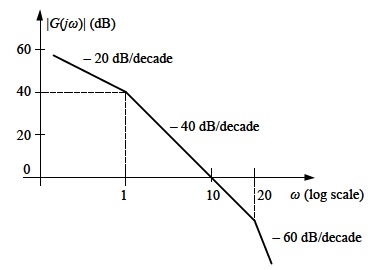
Consider the following two statements.

Statement I: Transfer function $G(s)$ has three poles and one zero.

Statement II: At very high frequency $(\omega \rightarrow \infty)$, the phase angle $\angle G(j \omega) = – \frac{3 \pi}{2}$.

Which one of the following options is correct?

  1. Statement I is true and statement II is false
  2. Statement I is false and statement II is true
  3. Both the statements are true
  4. Both the statements are false

Please log in or register to answer this question.

Related questions

0 0 votes
0 0 answers
259
259 views
Arjun asked Feb 12, 2019
259 views
The transfer function of a phase lead compensator is given by$$D(s) = \frac{3 \bigg( s+ \frac{1}{3T} \bigg)}{ \bigg( s+ \frac{1}{T} \bigg)}$$The frequency (in rad/sec), a...
0 0 votes
0 0 answers
85
85 views
gatecse asked Feb 23
85 views
The asymptotic Bode magnitude plot of a system is shown.Which one of the following options best represents the transfer function of the system?$G(s)=\dfrac{1+\dfrac{s}{\o...
0 0 votes
0 0 answers
273
273 views
Arjun asked Feb 12, 2019
273 views
A system transfer function is $H(s)= \frac{a_{1}s^{2}+b_{1}s+c_{1}}{a_{2}s^{2}+b_{2}s+c_{2}}.$ If $a_{1}=b_{1}=0,$ and all the other coefficient are positive, the transfe...
0 0 votes
0 0 answers
369
369 views
Arjun asked Feb 15, 2022
369 views
The damping ratio and undamped natural frequency of a closed loop system as shown in the figure, are denoted as $\zeta$ and $\omega_{n}$, respectively. The values of $\ze...
Position:
Show:
Answer: